Aerospace Parts Storage: The Complete Guide to Precision Components & Defence Manufacturing


In aerospace and defence manufacturing, a storage failure is not an operational inconvenience — it is a safety event. A contaminated precision bearing, an ESD-damaged avionics PCB, or a shelf-life-expired seal installed in an aircraft can cause catastrophic failure in service. The storage system for aerospace parts is not background infrastructure. It is a direct contributor to the airworthiness and operational reliability of every component that passes through it.
Why Aerospace Parts Storage Is Different from Standard Industrial Storage
Most industrial storage systems are designed around a single goal: putting parts away and getting them out again quickly. In aerospace and defence, three additional requirements make parts storage fundamentally more demanding:
Zero tolerance for contamination
Precision aerospace components — bearings, seals, actuator components, optical parts, and precision machined surfaces — have tolerances measured in microns. A particle of dust or a fingerprint can alter surface finish, introduce corrosion, or cause premature wear that is not detectable at installation but surfaces as a failure in service. Storage systems must physically exclude contamination, not just minimise it.
ESD is a silent destroyer
Modern aircraft and defence systems contain thousands of electronic components — avionics, radar systems, sensors, flight control electronics, and communication equipment. Every one of these is potentially vulnerable to electrostatic discharge (ESD). Unlike mechanical damage, ESD damage is usually invisible. A component destroyed by ESD may test within specification on the bench but fail in service under the stress of actual operation. In an aircraft or missile system, that field failure can be catastrophic.
Full traceability is non-negotiable
All major aerospace and defence prime contractor requirements mandate complete traceability for every stored component — part number, revision, lot/batch number, supplier, shelf-life expiry date, and storage history. If a component cannot be traced to its exact storage location and handling history, it cannot be released for use on an aerospace structure or defence system. The storage system must support — not obstruct — this traceability requirement.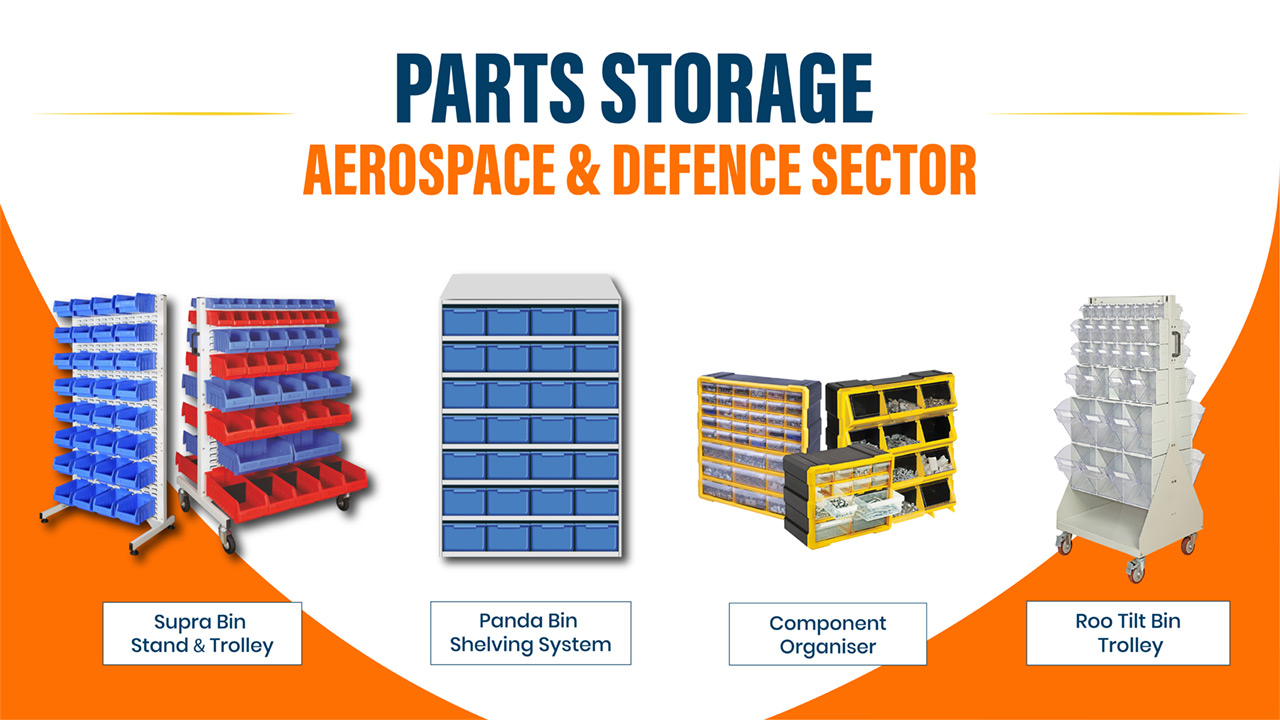
"In aerospace, the consequence of a storage failure is not a delay or a cost write-off. It is a component installed in a platform that may not fail until it is critical – and then fail completely."
India's Growing Aerospace & Defence Sector — Storage Standards Are Rising
India's aerospace and defence manufacturing ecosystem is expanding rapidly. The government's Aatmanirbhar Bharat initiative is driving indigenisation of defence equipment, with HAL, BEL, DRDO, ISRO, and a growing private sector — including Tata Advanced Systems, Mahindra Defence, L&T Aerospace, Safran India, and Airbus India — all expanding production capacity.
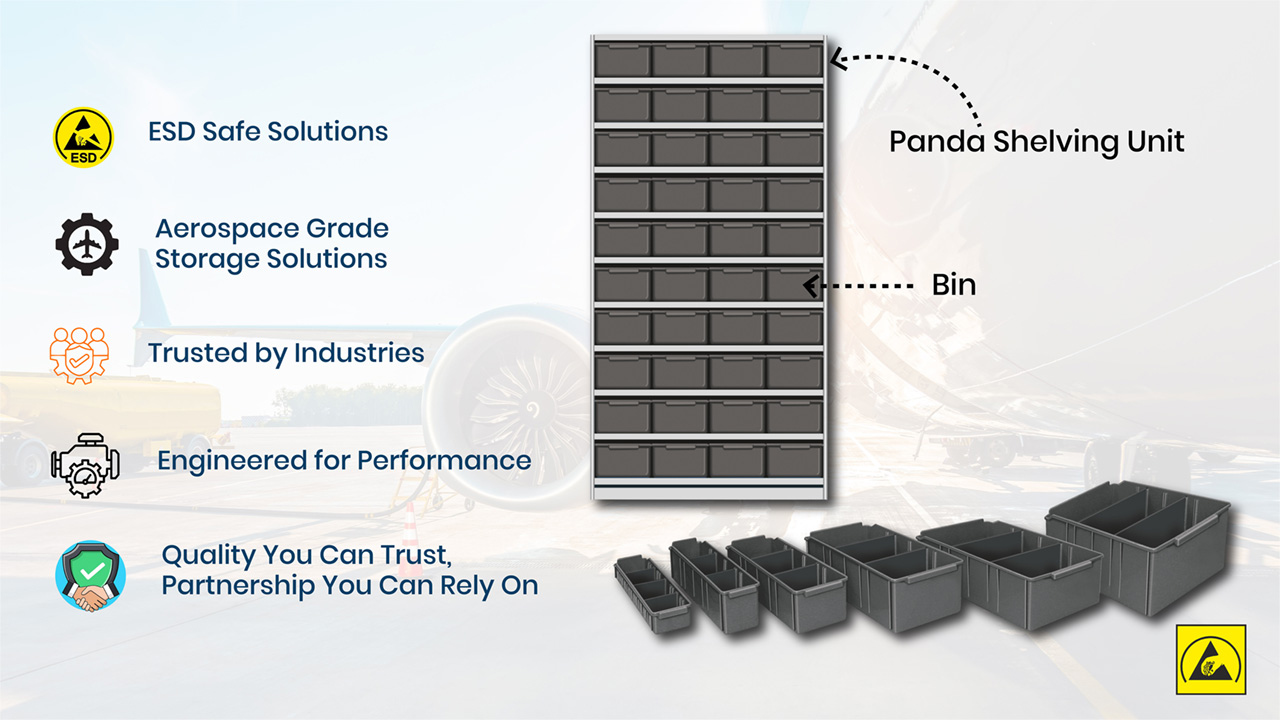
Alkon Plastics has been supplying ESD-safe bins, Panda Shelving systems precision parts storage solutions to Indian aerospace and defence facilities for over 20 years.
Frequently Asked Questions
Why is ESD protection critical in aerospace parts storage?
Electrostatic discharge (ESD) can destroy sensitive aerospace electronic components in microseconds with no visible external damage. These latent ESD failures may pass bench testing but fail in service under operational stress — with catastrophic safety consequences in an aircraft or defence system. MIL-STD-1686 and JESD625 mandate ESD-safe storage for all sensitive components, and AS9100 auditors will verify compliance with these requirements during every surveillance audit.
Can Alkon provide ESD bin test certficates for aerospace audits?
Yes. Alkon Plastics can provide surface resistivity test certificates for its ESD-safe conductive bin range upon request.