Plastic vs Metal Storage Containers: Which Is Better for Industrial Storage?
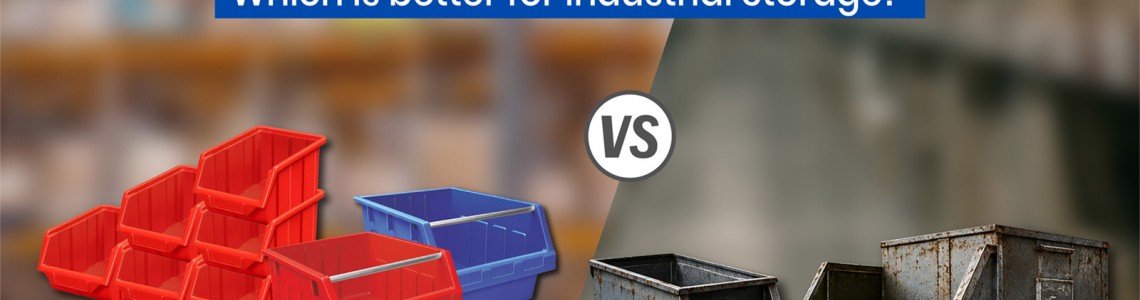
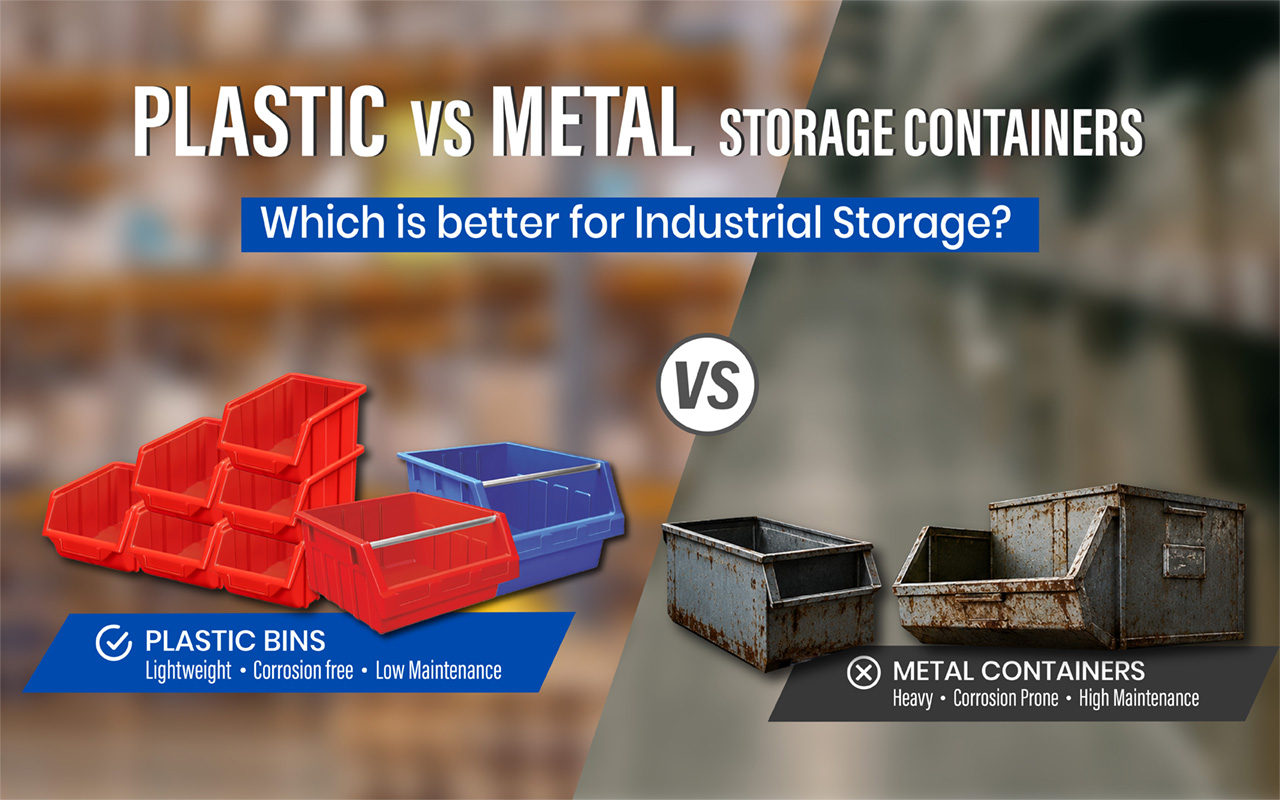
We compare plastic and metal storage containers across 10 real-world factors — cost, durability, weight, corrosion, hygiene, ergonomics, and more — so you can make the right choice for your facility.
It is one of the most common questions in industrial procurement: plastic bins or metal containers? Both are widely used. Both have genuine strengths. But the answer is rarely "it depends" — in most industrial environments, one material clearly outperforms the other on the factors that matter most: total cost over time, safety, hygiene, and operational efficiency. This guide gives you the honest comparison.
1. At a Glance — Plastic vs Metal Storage Containers
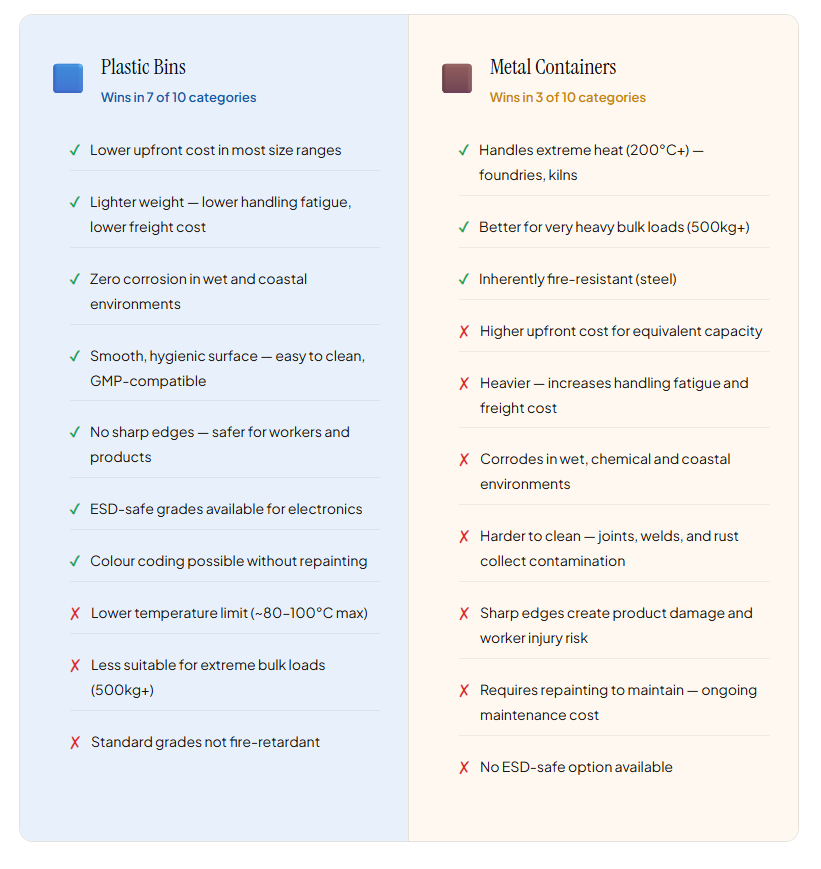
2. Head-to-Head Comparison
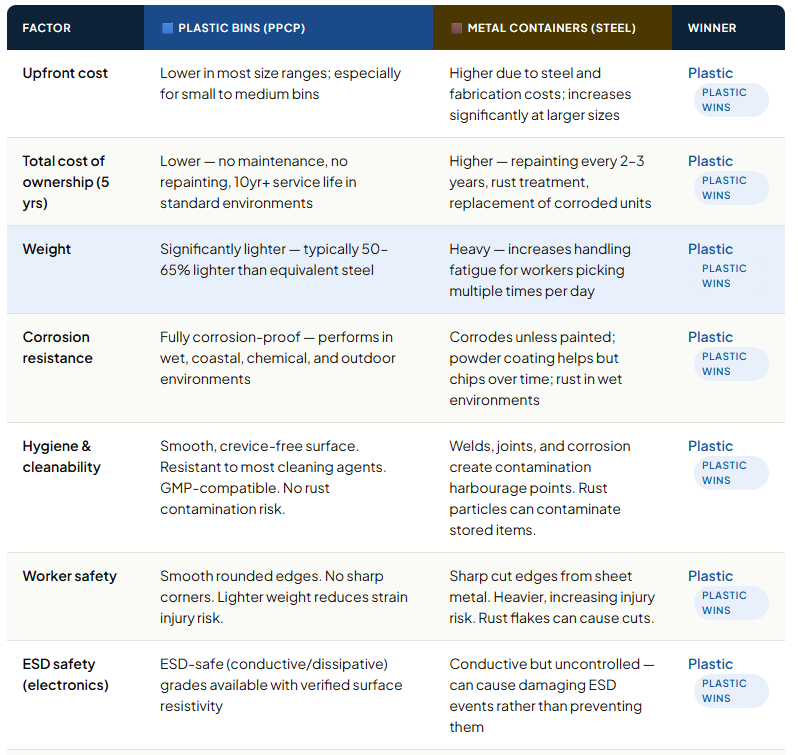
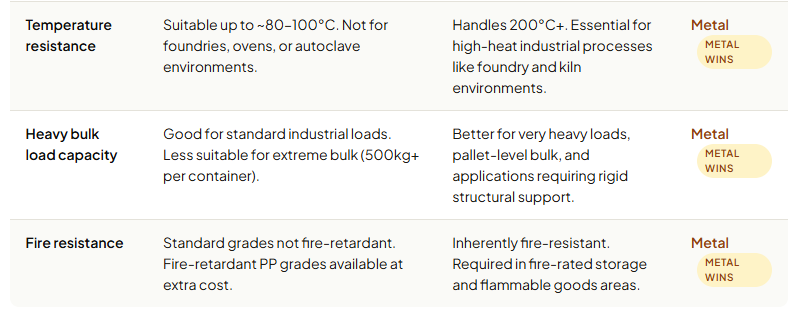
3. Cost & Total Cost of Ownership
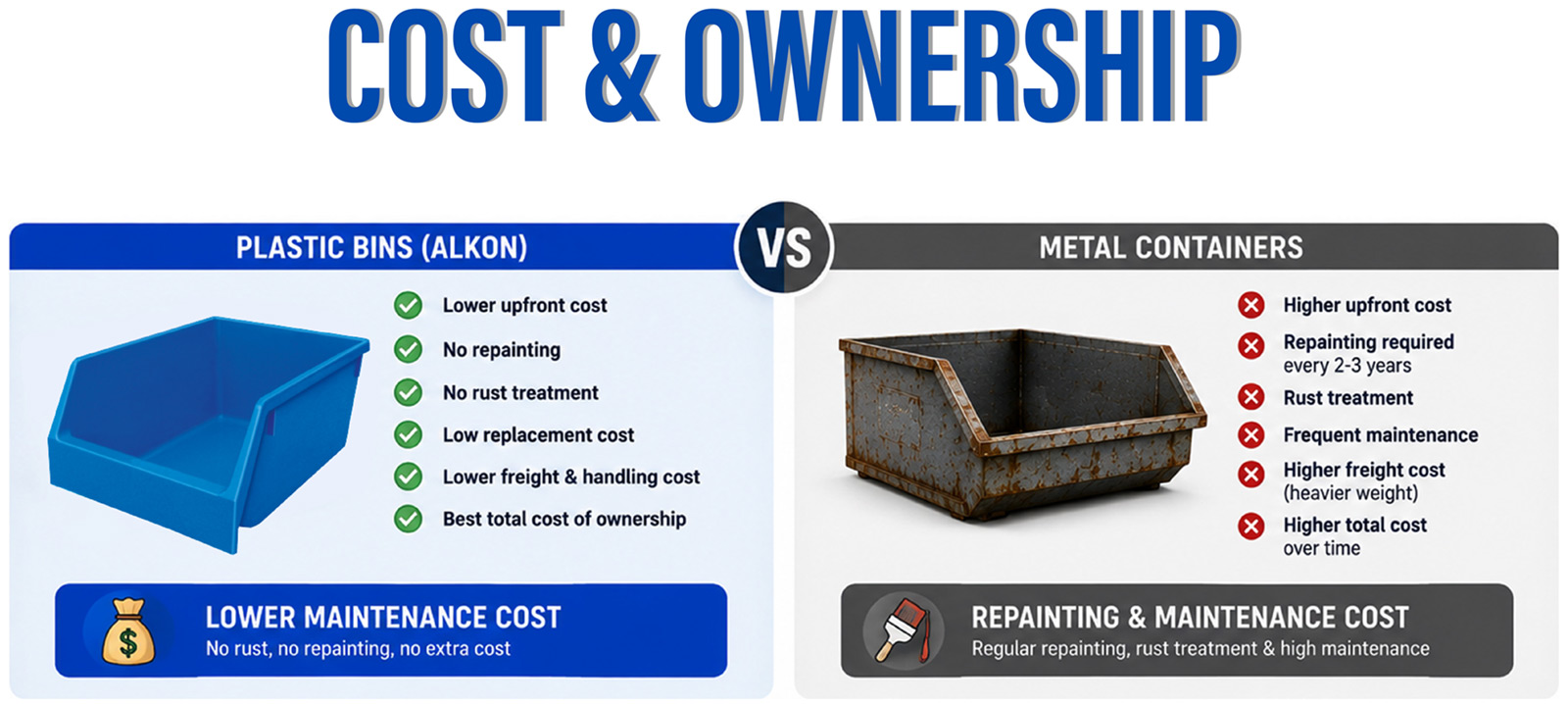
Procurement decisions that look only at the unit price of a bin are making a common mistake. The true cost of a storage container is the total cost of ownership (TCO) — upfront price, installation cost, maintenance cost, replacement frequency, and the operational cost of any inefficiencies the container creates.
Upfront cost
Quality PPCP plastic bins are typically lower in upfront cost than equivalent powder-coated steel containers across the small-to-medium size range that covers 90% of industrial bin applications. The cost gap narrows in very large, heavy-duty bulk containers — but even there, plastic Mammoth Bins and Bull Bins are cost-competitive with steel alternatives.
Maintenance cost
This is where plastic wins decisively. PPCP plastic bins require zero maintenance — no repainting, no rust treatment, no replacement of corroded units. Powder-coated steel bins typically need repainting every 2–3 years in normal industrial environments and sooner in wet, chemical, or coastal facilities. The labour and material cost of maintaining metal bin surfaces adds up significantly over a 5–10 year period.
Freight and handling cost
Plastic bins are 50–65% lighter than equivalent steel containers. In large installations involving hundreds or thousands of bins, lighter containers mean lower freight costs on delivery, lower handling effort during installation and rearrangement, and reduced workplace injury risk — all with measurable cost implications.
4. Durability & Service Life
A common misconception is that metal containers are inherently more durable than plastic. In practice, durability depends entirely on the material grade, the environment, and the type of abuse the container is exposed to.
PPCP plastic durability
Polypropylene Copolymer (PPCP) — the material used in Alkon's industrial bin range — is engineered specifically for demanding industrial environments. It offers high impact resistance against drops and daily rough handling, resistance to most industrial chemicals and cleaning agents, dimensional stability across a wide temperature range (–20°C to +80°C), and UV resistance for outdoor storage applications. Alkon PPCP bins have a demonstrated service life of 10 years or more in heavy-duty warehouse use.
Steel container durability
Unpainted or inadequately protected steel containers begin corroding within months in humid Indian environments. Powder-coated steel performs better but the coating chips and scratches over time, exposing bare metal to corrosion. In coastal areas like Mumbai, Chennai, and Kochi, or in wet production environments, metal bin degradation accelerates significantly. Even galvanised steel requires periodic inspection and treatment in these conditions.
5. Weight & Ergonomics
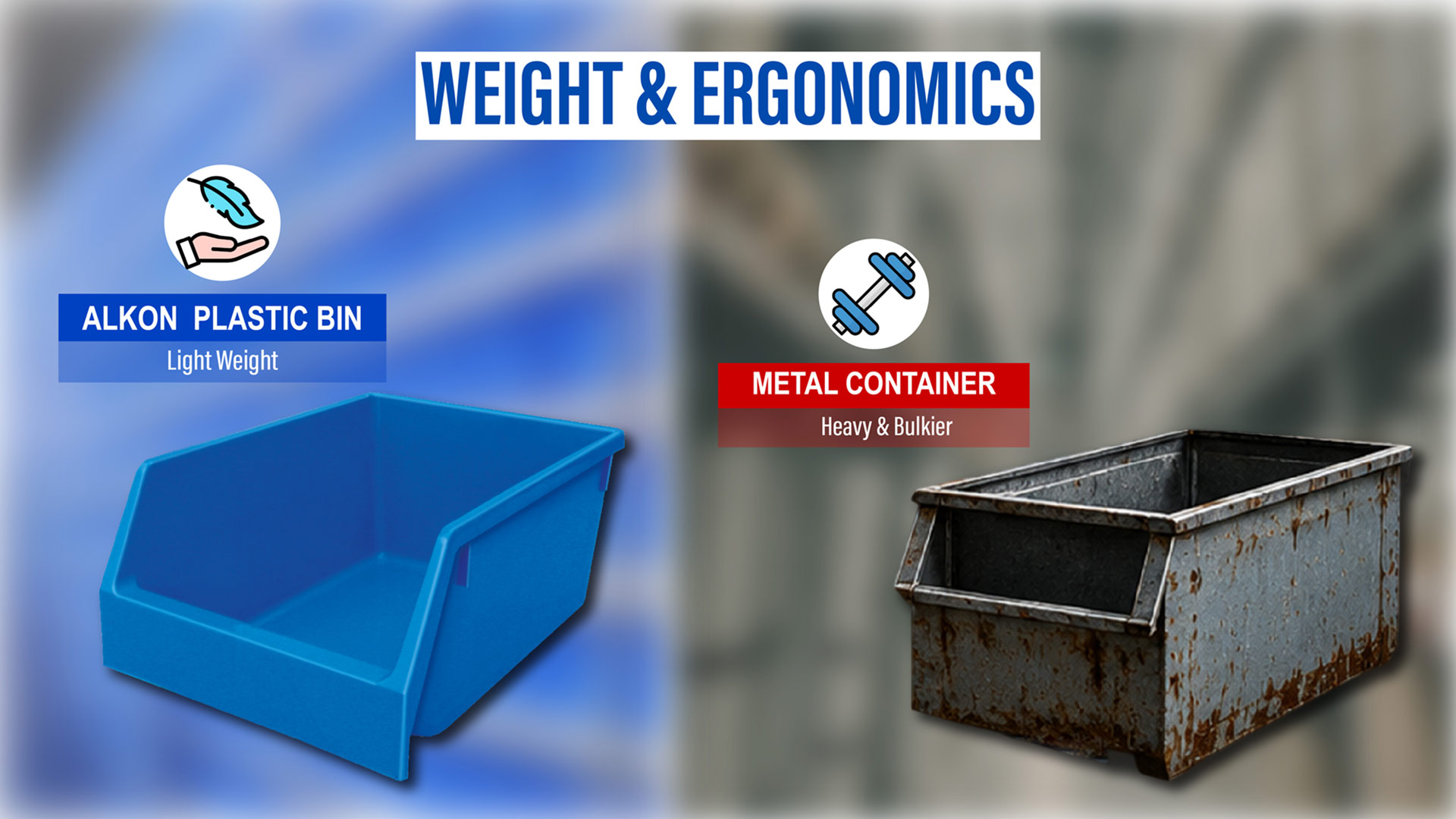
In high-frequency picking environments, the weight of a storage container is not a minor consideration — it directly affects worker fatigue, injury rates, and picking speed across an entire shift.
A typical medium-sized plastic shelf bin weighs 0.3–0.8 kg empty. An equivalent steel container typically weighs 1.5–3.5 kg. Over a shift where a worker handles hundreds of containers, this difference accumulates into significant fatigue and injury risk. The HSE (Health & Safety) data is clear: heavier manual handling equipment directly increases musculoskeletal injury rates.
Beyond individual ergonomics, lighter bins also mean lower installation effort when setting up or reconfiguring a storage system, lower freight costs on delivery, and easier rebalancing of bin positions as product mix changes over time.
6. Corrosion & Chemical Resistance
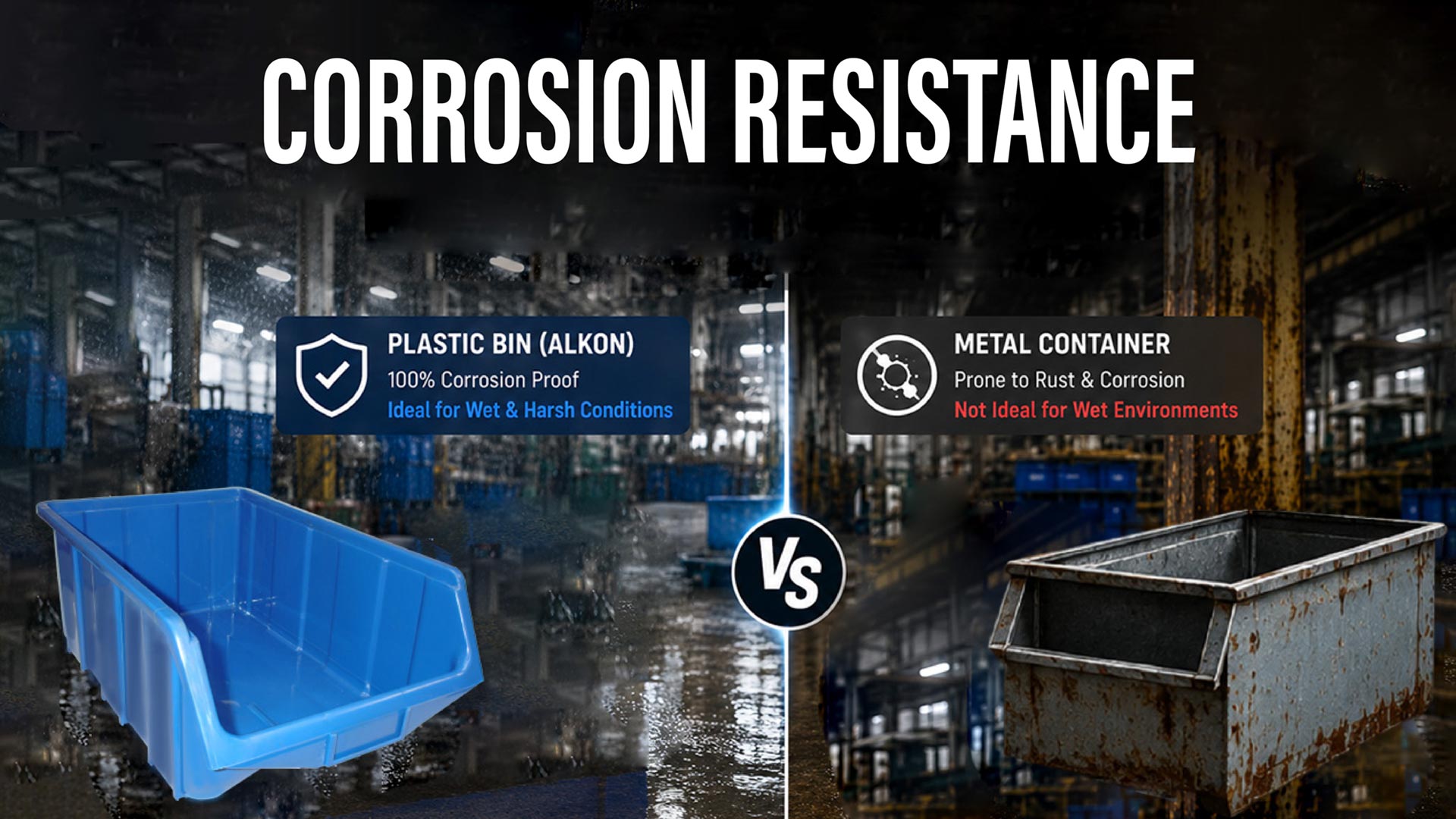
Corrosion is the most damaging long-term failure mode for metal containers in industrial storage. It affects not just the container itself, but the items stored inside — metal particles and rust flakes contaminate pharmaceutical products, electronic components, food ingredients, and precision automotive parts.
Plastic — zero corrosion risk
PPCP plastic does not corrode, rust, or degrade in the presence of water, humidity, or most industrial chemicals. It is chemically resistant to oils, solvents, acids, and alkalis at the concentrations typically encountered in Indian industrial and warehouse environments. In wet environments, cold stores, and outdoor storage, plastic bins maintain their structural integrity and clean surface indefinitely.
Metal — corrosion is inevitable without continuous maintenance
Even high-quality powder-coated steel containers develop corrosion at points where the coating is chipped, scratched, or worn by regular use. This is not a question of if — it is a question of when. In Indian coastal and humid environments, the timescale is compressed significantly. Stainless steel addresses corrosion but at a cost premium that makes plastic bins even more economically attractive by comparison.
7. Hygiene & Cleanability
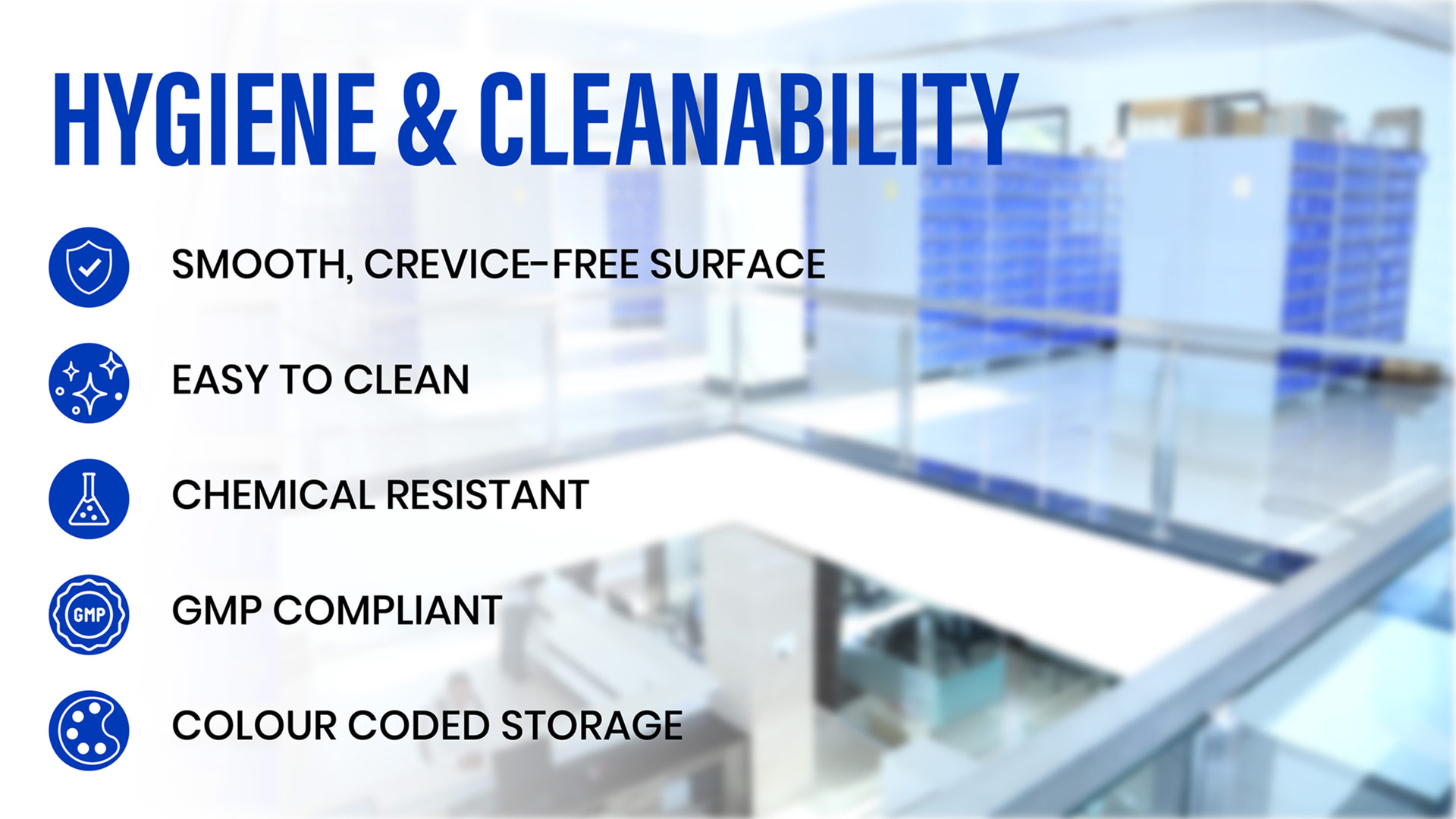
In pharmaceutical, healthcare, food, and FMCG environments, the hygiene properties of storage containers are not optional — they are regulatory requirements. This is where plastic has its most decisive advantage over metal.
| Smooth, crevice-free surface: | PPCP plastic bins have a moulded smooth surface with no weld lines, joints, or seams that can harbour bacteria, fungal contamination, or residue from stored products. Metal containers always have welded joints and seams that are difficult to clean completely. |
| No rust contamination: | Metal particle and rust flake contamination is a genuine risk in pharmaceutical, food, and cosmetic storage environments. PPCP plastic eliminates this risk entirely — there is no metal to shed. |
| Compatible with industrial cleaning agents: | PPCP is resistant to the quaternary ammonium compounds, hydrogen peroxide, and alcohols commonly used for pharmaceutical and food-grade cleaning. Metal can corrode with certain cleaning agents. |
| GMP compliance: | Good Manufacturing Practice guidelines in pharmaceutical and food industries require smooth, cleanable, non-shedding storage surfaces. PPCP plastic bins meet these requirements; standard steel containers typically do not without significant modification or stainless steel specification. |
| Colour coding for hygiene segregation: | Plastic bins can be manufactured in different colours to support hygiene segregation — quarantine vs released stock, clean vs dirty areas, allergen vs non-allergen zones. Metal bins require expensive repainting to achieve this. |
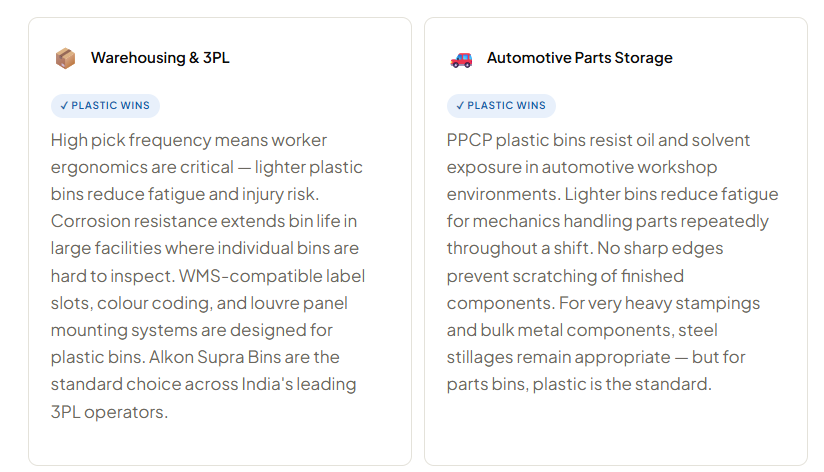
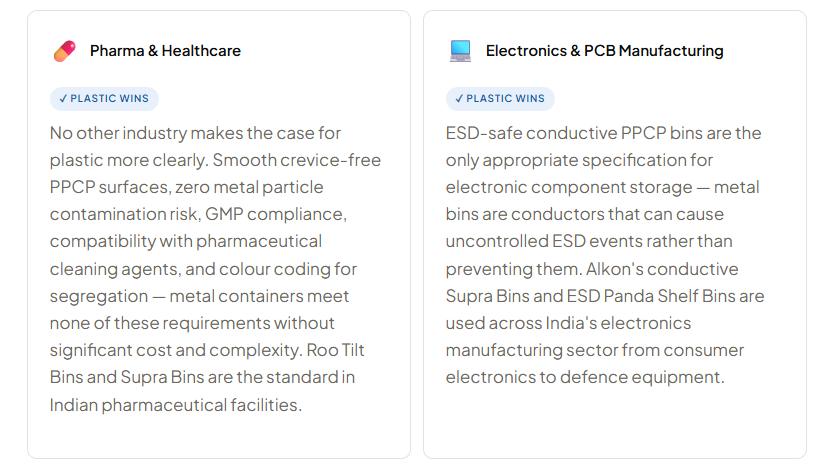
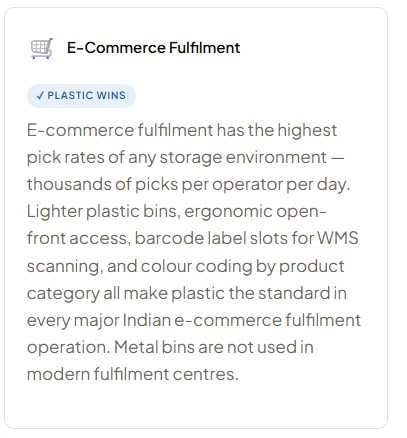
8. Industry-by-Industry Verdict
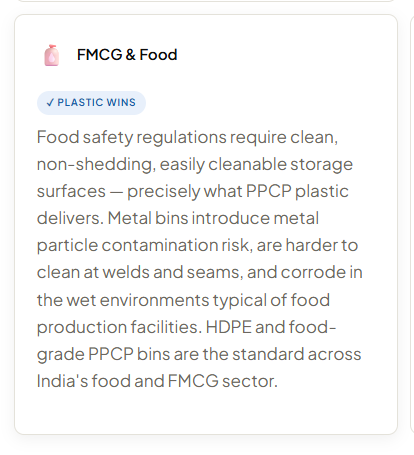
9. Frequently Asked Questions
Are plastic storage containers better than metal for industrial use?
For most industrial storage applications, plastic bins outperform metal on cost, weight, corrosion resistance, hygiene, and ergonomics. Metal containers have an advantage only in extreme heat (above 100°C), very heavy bulk storage (500kg+), and applications requiring absolute fire resistance. For warehouses, pharma, electronics, automotive parts, and retail, quality PPCP plastic bins are the better choice in almost every case.
Do plastic storage bins last as long as metal bins?
Quality PPCP plastic bins have a service life of 10 years or more in typical Indian industrial environments — comparable to well-maintained powder-coated steel bins, and significantly longer than inadequately maintained or corroded metal containers. In wet, chemical, or coastal environments, plastic bins outlast metal substantially. The key is material grade: PPCP is engineered for industrial durability in a way that cheap recycled plastic is not.
Which is better for pharmaceutical storage — plastic or metal?
Plastic is far better for pharmaceutical storage. Smooth PPCP or HIPS surfaces have no rust risk, no metal particle contamination, are easy to clean with industrial agents, and meet GMP hygiene requirements. Metal bins corrode in humid dispensary environments and create contamination risk. Every major Indian pharmaceutical manufacturer and hospital uses plastic bins for dispensary and component storage.
Are plastic bins cheaper than metal bins?
Yes, in most cases — and the gap widens significantly when you account for total cost of ownership. Plastic bins have a lower upfront cost in most size ranges, zero maintenance cost (no repainting or rust treatment), lower freight cost due to lighter weight, and comparable or longer service life. Over 5–10 years, quality plastic bins almost always deliver lower total cost than equivalent steel containers.
Can plastic bins be used outdoors?
Yes. UV-stabilised PPCP plastic bins can be used in outdoor storage environments. Unlike metal, they will not corrode in rain or humidity. Extended direct sunlight exposure will cause gradual colour fading over many years, but structural integrity is maintained. For outdoor applications, specify UV-stabilised grades — standard Alkon Supra Bins include UV stabilisation.